Connecting craft production, hospitality and franchising
A specialty beverage operator planned to launch with imported products, route demand through destination venues and smaller tasting locations, add retail distribution, and later move part of supply into local production. Some venues would be company-owned while others would expand through franchise partners.
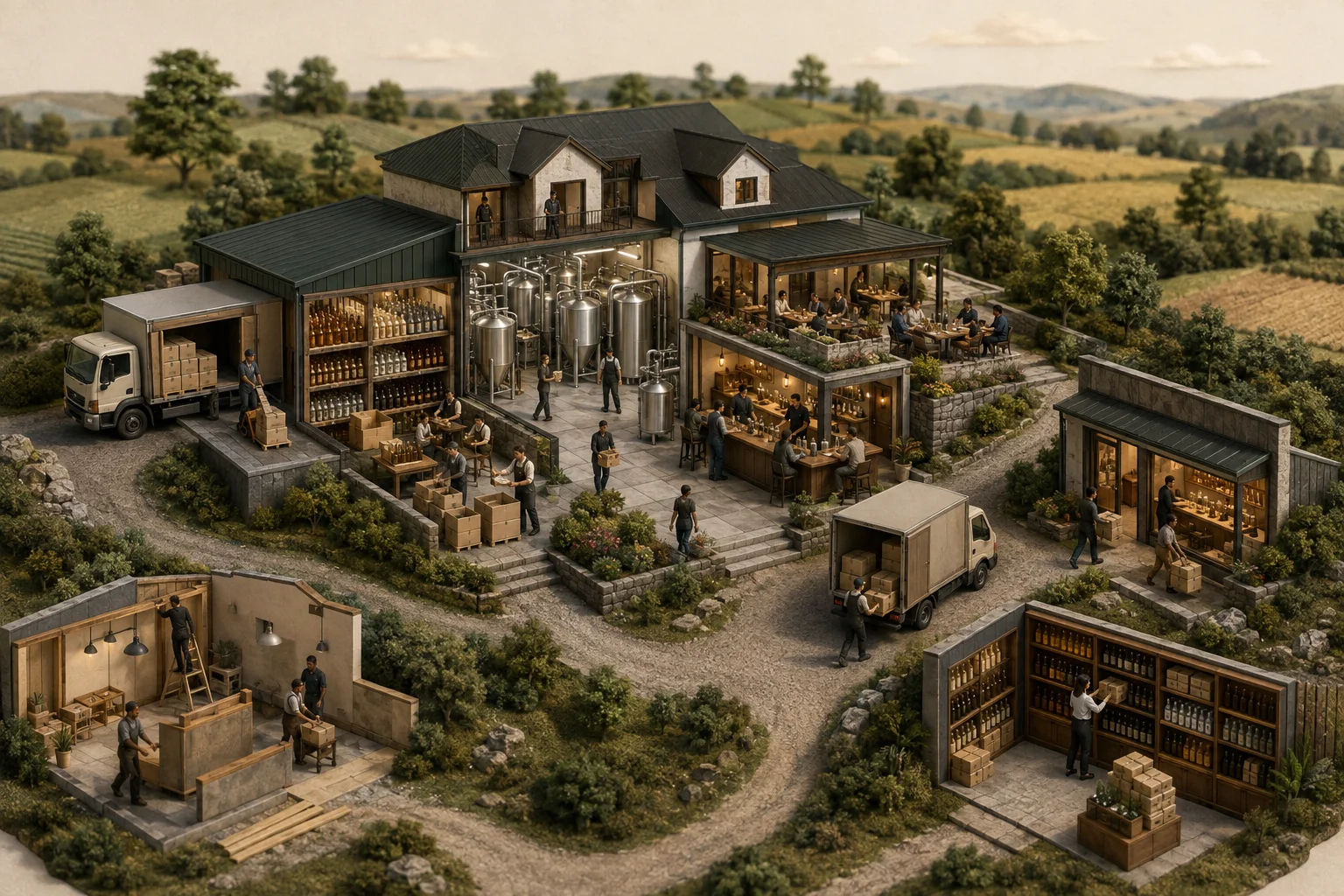
Imported inventory and later local production require different cost, capacity and cash assumptions.
Destination properties and smaller tasting locations use different demand and operating drivers.
Corporate sites consume capital while partner-operated sites create fees, royalties and supply relationships.
Venue consumption, take-home purchases and third-party retail each retain a different contribution.
WHY THIS WASN’T A TEMPLATE EXERCISE
The model had to respect
how the business actually moved.
The reconstructed operating model separates beverage volume, destination-property economics, smaller-venue performance, retail contribution, franchise revenue, import-to-production timing, working capital and rollout funding.
One concept crossed three operating models
The plan combined a beverage company, destination hospitality and a franchise network. Product units, guest nights and operating locations could not be forced into one generic revenue-growth assumption.
The venues were both customers and distribution assets
A destination property could earn from rooms, food, experiences and on-site beverage sales while also supplying smaller locations. The consolidated view needed to show where margin was created without counting internal product transfers twice.
Supply economics changed midway through the plan
The launch relied on imported finished goods, while the later vision introduced local production. Landed cost, inventory lead time, brewing capacity, labor, capital expenditure and ramp risk therefore belonged in separate phases.
Franchising shifted capital but not operating accountability
Partner-operated venues could accelerate the footprint with less corporate investment, yet their sales, labor, occupancy and supply economics still had to work before franchise fees or royalties were credible.
MODEL ARCHITECTURE
From operating activity
to a decision-ready view.
Each layer has one job. Together they keep the commercial story, unit economics and cash consequences on the same timeline.
Product and supply phases
An expandable product schedule distinguishes imported supply from later local production, with its own unit cost, lead time, capacity and launch timing.
Volume allocation
Available beverage volume flows to destination properties, smaller tasting venues, local partners and retail before revenue is recognized by channel.
Destination venue operations
Rooms, occupancy, guest rates, food-and-beverage covers and paid experiences build a site-level operating statement around the production hub.
Smaller venue unit economics
Visits, on-site consumption, take-home purchases, staffing, occupancy cost and opening timing define the compact tasting-location format.
Franchise rollout
Company-owned and partner-operated openings remain separate, with development fees, recurring royalties and product-supply income linked to active locations.
Channel contribution
Direct venue sales, retail distribution and internal supply transfers reconcile into product and venue contribution without duplicate group revenue.
Capital and cash
Venue works, production equipment, opening costs, inventory and working capital roll into a phased funding requirement and downside scenarios.
WHAT THE ANALYSIS SURFACED
Useful answers,
without exposing client data.
The takeaways are intentionally qualitative. Exact assumptions, calculations and outputs remain inside the confidential client model.
The destination site was more than a hospitality property
Its rooms and restaurant created customer revenue, while production and distribution made it a regional supply hub. Evaluating only room profitability would miss a substantial part of the network logic.
Local production was a phase change, not a lower cost line
Moving from imported finished goods to manufacturing introduced equipment, utilization, yield, labor and inventory timing. A blended product margin would conceal the cash and execution risk of that transition.
Self-distribution exchanged fees for operational load
Selling through controlled venues could retain more gross margin, but it also required enough local volume, inventory and logistics support. The channel comparison therefore had to include both contribution and working capital.
Franchise growth needed two viable profit statements
Fees and royalties could look attractive to the network owner even when a partner venue struggled. Testing both franchisor income and franchisee-level cash generation made the rollout assumptions more credible.
MODELING APPROACH
The working system
behind the answer.
- Central assumptions, rollout calendar and scenario controls
- Expandable product, supply-source and landed-cost schedule
- Import, local-production, inventory and channel-allocation model
- Destination property revenue, cost and operating statement
- Smaller tasting-venue unit-economics model
- Company-owned and franchise partner economics
- On-site, local-partner and retail channel contribution
- Consolidated profit and loss, cash flow, funding and sensitivities
CASE CONFIDENTIALITY
This anonymized case explains the beverage-supply, hospitality, distribution and franchise logic without naming the company, founders, managers, import partners, products, venues, property partners, franchise operators, distributors, retailers, advisers, charities, locations or dates. Exact product claims, recipes, styles, launch assortment, exclusivity terms, awards, prices, market estimates, market-share assumptions, site counts, room inventories, property designs, production capacity, rollout timing, costs, margins, franchise terms, forecasts and funding needs remain private because the source plan is explicitly confidential and client engagements may be NDA-protected. The business-plan pages, photographs, diagrams, names, formulas and model screenshots are not reproduced. The illustration is an original fictional hospitality and production network rather than a real property, beverage brand, facility or operating result.