Testing a golf club refurbishment across the life of the lease
A long-lease golf club needed an investment model that treated golf, the driving range, memberships, retail, food and beverage, lodging, rentals and an annual tournament as connected but distinct businesses. Refurbishment and maintenance had to share the same capital plan.
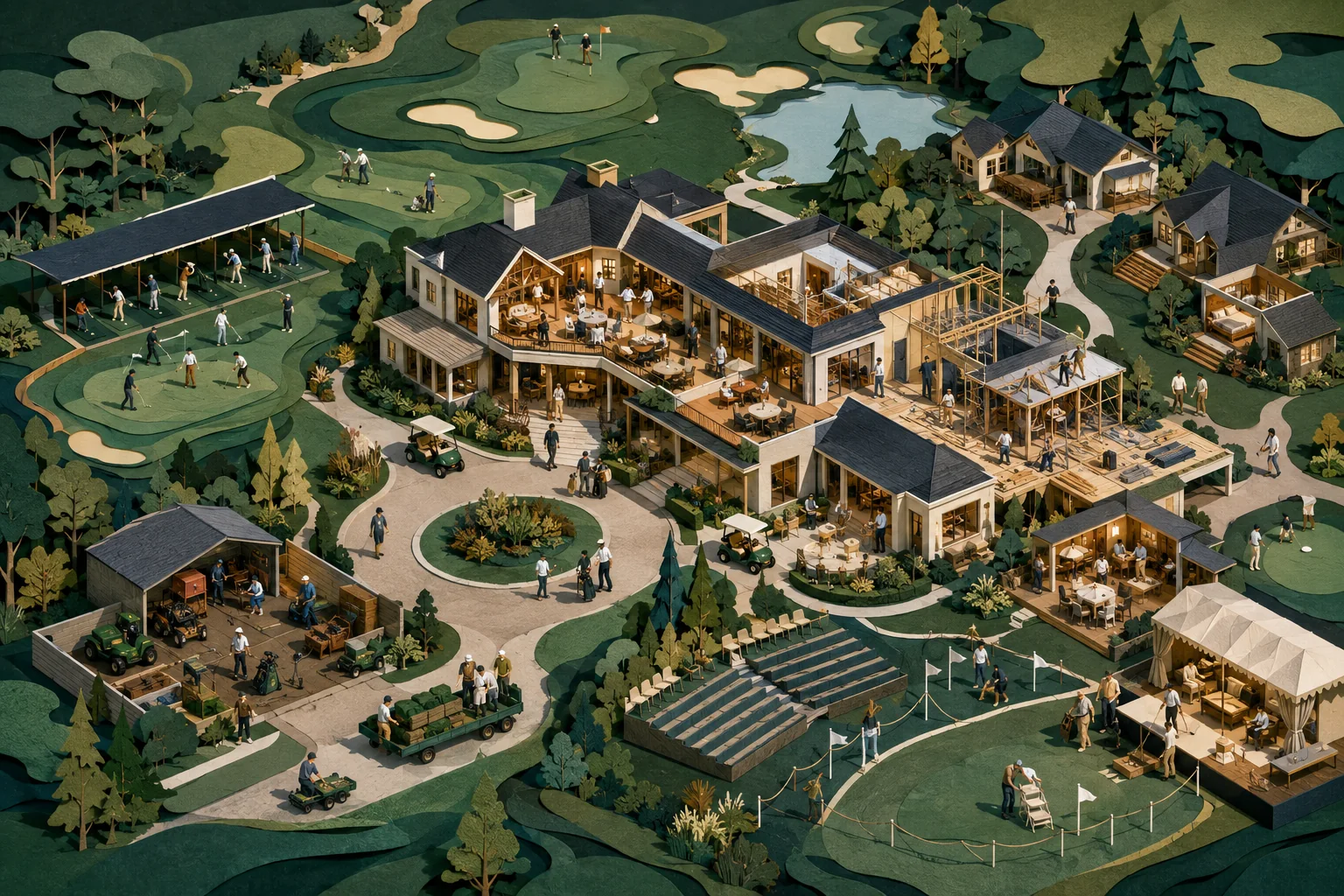
The operating forecast needed to span the lease while remaining adjustable for earlier termination.
Golf, memberships, the range, hospitality, lodging, events, rentals and retail required different activity drivers.
Tournament sponsorship and event costs created a recurring but concentrated operating period.
Asset performance and shareholder returns needed to remain distinct once debt entered the capital structure.
WHY THIS WASN’T A TEMPLATE EXERCISE
The model had to respect
how the business actually moved.
The reconstructed architecture connects member and visitor activity to each revenue engine, gives tournaments and maintenance their own calendars, and then carries operations into financing, valuation and alternative lease-horizon scenarios.
The club was several businesses sharing one property
Course access, memberships, the driving range, food and beverage, lodging, pro-shop sales, rentals and events each relied on a different mix of visitors, participation, price and direct cost.
Maintenance had its own operating clock
Turf, machinery and fast-wearing components needed remedial, periodic and preventive care. Treating upkeep as a flat percentage would hide when the operating asset itself required cash.
The tournament created a second event economy
Sponsorship revenue arrived alongside purse, sanction, production, media, hospitality and operations costs. Those flows had to be visible before they were consolidated with ordinary club activity.
The lease, debt and refurbishment ran on different horizons
A long operating right could support investment, but financing amortized on its own schedule and an earlier lease exit could shorten the cash flows supporting valuation.
MODEL ARCHITECTURE
From operating activity
to a decision-ready view.
Each layer has one job. Together they keep the commercial story, unit economics and cash consequences on the same timeline.
Members and visitors
Membership movement, total visitors and participation assumptions establish the customer base before revenue is calculated.
Club activity
Golf rounds and driving-range use translate customer activity into operating volume on their own schedules.
Hospitality and retail
Food and beverage, lodging, rentals and pro-shop units connect participation to price, inventory and direct cost.
Annual tournament
Sponsorship categories and event costs sit in a separate dated budget before rolling into the club forecast.
Refurbishment and upkeep
Initial upgrades, recurring maintenance and equipment replacement create timed capital and operating cash needs.
Financing and value
Debt, shareholder capital, project cash flow, equity cash flow, valuation and sensitivities reconcile across alternative horizons.
WHAT THE ANALYSIS SURFACED
Useful answers,
without exposing client data.
The takeaways are intentionally qualitative. Exact assumptions, calculations and outputs remain inside the confidential client model.
Revenue mix mattered more than one club-wide growth rate
A change in members, visitors or participation affected each activity differently. Separating volume from price made it possible to see whether growth came from access, hospitality, retail or events.
Maintenance protected the revenue asset
Grounds and equipment upkeep could not be treated only as overhead. Timing maintenance against use and replacement cycles made the cost of keeping the club saleable and playable visible.
The tournament needed to stand on its own first
A recurring event could add sponsor and hospitality income while consuming substantial cash in a concentrated period. Its contribution was clearer when the event budget remained separate before consolidation.
An earlier lease exit could change more than terminal value
Shortening the horizon affected operating cash flow, residual value and the debt position at exit. Horizon control therefore belonged inside the financing and return analysis rather than only in a valuation cell.
MODELING APPROACH
The working system
behind the answer.
- Long-range operating forecast with editable lease horizon
- Membership, visitor, golf and driving-range activity schedules
- Hospitality, lodging, rental and pro-shop revenue modules
- Inventory, food and beverage and activity-level direct-cost schedules
- Annual tournament sponsorship, event-cost and cash budget
- Turf, equipment, upkeep and replacement schedule
- Refurbishment, debt, shareholder capital and integrated cash plan
- Project and equity return, valuation, dashboard and sensitivity views
CASE CONFIDENTIALITY
This anonymized case explains the golf-club operating, refurbishment, tournament, financing and valuation logic without naming the client, shareholders, club, location, jurisdiction, event, advisers or dates. Exact lease terms, financing amounts, rates, operating volumes, prices, event budgets, maintenance assumptions, valuation inputs, forecasts and returns remain private because client work can be confidential or NDA-protected. The linked reference and any source attachments are not reproduced. The illustration is an original fictional club rather than a real property, layout, event, client deliverable or operating result.