Modeling a hospital from service lines to investor returns
A planned multi-specialty hospital needed a flexible financial model adapted from an existing healthcare feasibility template. The new architecture had to connect inpatient and outpatient service lines, clinical capacity, construction investment, financing, working capital and a possible later exit while translating the reference material into a different reporting convention.
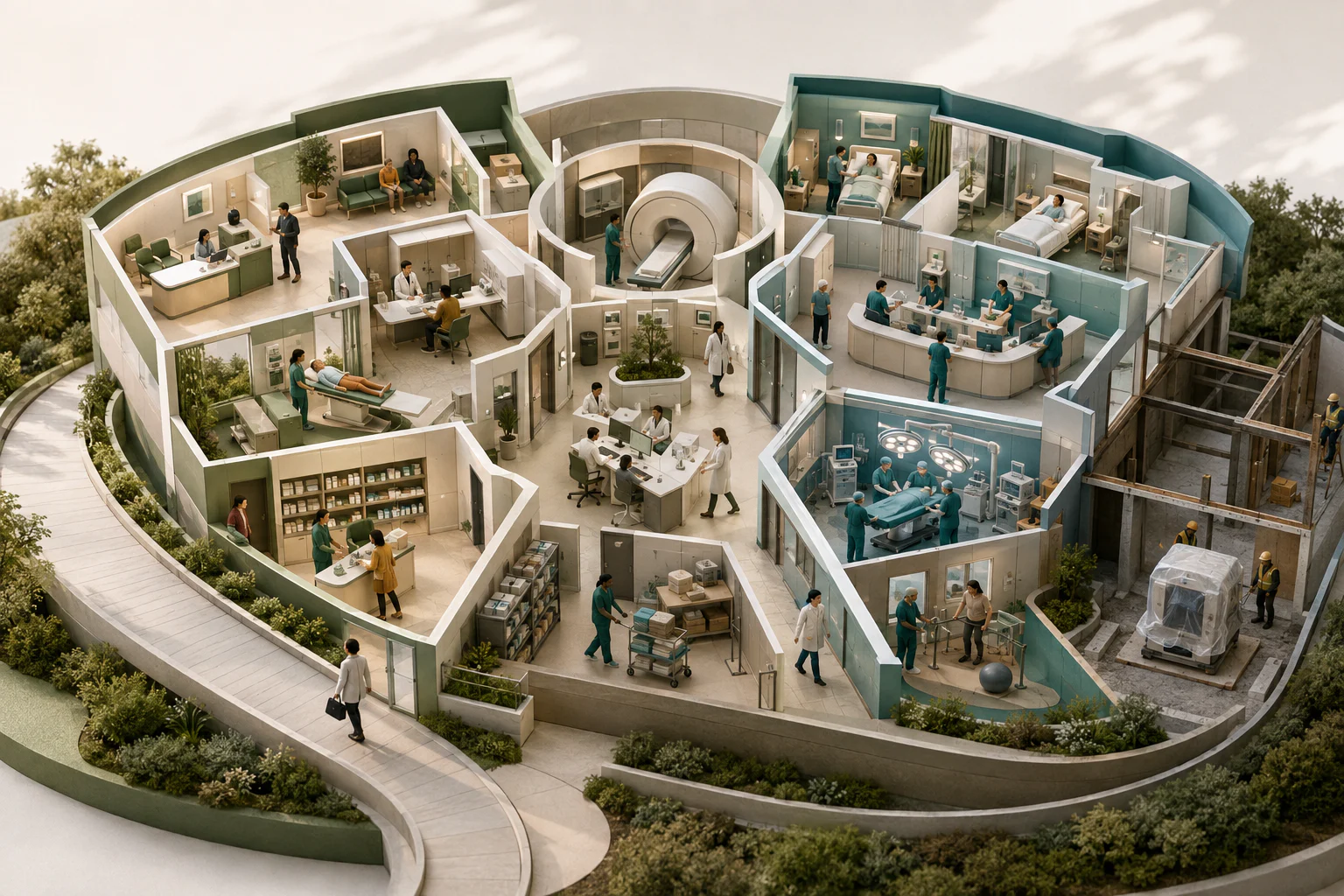
Admissions, consultations, procedures, diagnostics and pharmacy activity remain visible as separate service mechanics.
Beds, clinics, rooms, chairs, procedures and working days define different operating limits.
Construction, equipment and pre-opening cash precede the utilization ramp and debt repayment.
Asset-level performance and shareholder returns are separated rather than blended into one headline metric.
WHY THIS WASN’T A TEMPLATE EXERCISE
The model had to respect
how the business actually moved.
The model structure links service-line activity to beds, clinics and procedure capacity, then carries departmental contribution through development spending, financing, cash flow, valuation and investor returns.
Capacity had more than one denominator
Hospital activity could not be reduced to a bed-occupancy assumption. Outpatient clinics, procedure rooms, diagnostics, pharmacy and inpatient bed-days each required their own throughput logic.
The service catalog had to expand safely
A later change added dozens of inpatient and outpatient input rows. The formulas, departmental subtotals and outputs needed to extend with the service catalog rather than depend on a fixed template range.
The capital and operating clocks overlapped
Construction, equipment, pre-opening costs and working capital occurred before utilization stabilized, while debt grace, repayment and a possible exit followed their own timelines.
MODEL ARCHITECTURE
From operating activity
to a decision-ready view.
Each layer has one job. Together they keep the commercial story, unit economics and cash consequences on the same timeline.
Clinical service catalog
Expandable inpatient and outpatient rows hold service-specific volume, price, payer and direct-cost assumptions.
Capacity and utilization
Beds, available bed-days, clinics, rooms, chairs, procedures and working days translate the clinical program into feasible activity.
Revenue and collections
Billing timing, payer mix, collection days and rejected claims bridge delivered care to recognized revenue and cash.
Departmental contribution
Staffing, consumables, pharmacy and other direct costs reveal contribution by service before shared hospital overhead.
Development and financing
Site, construction, equipment, professional fees, pre-opening spend and contingencies are phased alongside debt, equity, grace and repayment.
Cash and valuation
Integrated statements, depreciation, free cash flow and a selectable exit year connect operating performance to project and shareholder returns.
WHAT THE ANALYSIS SURFACED
Useful answers,
without exposing client data.
The takeaways are intentionally qualitative. Exact assumptions, calculations and outputs remain inside the confidential client model.
Adding rows was an architecture test, not a formatting request
A model designed around a fixed list of services becomes fragile as the clinical program changes. An expandable service catalog keeps formulas and summaries intact when departments are refined.
One occupancy rate could not explain utilization
Inpatient bed-days and outpatient visits consume different resources. Separating capacity units prevents a strong outpatient ramp from disguising an inpatient bottleneck—or the reverse.
The investor view needed one assumption spine
Reference materials used several timing, funding, discount-rate and reporting conventions. Reconciliation controls were necessary so construction, debt, statements and valuation all responded to the same scenario.
Operating profit did not automatically create an investable project
A hospital can reach a healthy operating margin and still produce fragile returns if the ramp is slow, development spending moves or the valuation relies too heavily on a distant exit assumption.
MODELING APPROACH
The working system
behind the answer.
- Expandable inpatient and outpatient service-line assumptions
- Capacity and utilization schedules by clinical resource
- Payer, billing, collection and working-capital logic
- Departmental revenue, direct-cost and contribution schedules
- Staffing, pharmacy, rejection and shared-overhead assumptions
- Development cost, equipment, depreciation and replacement-capex plan
- Debt, equity, grace-period, repayment and cash schedules
- Integrated statements, selectable exit valuation and return sensitivities
CASE CONFIDENTIALITY
This anonymized case explains the operating and investment logic without naming the hospital, sponsor, consultants, market, currency, dates, capacity, costs or returns. The financial teaser, architectural renders, floor plans and source model remain private. The illustration is an original fictional hospital operating system rather than a real building, clinical layout or client design.