Making channel growth answer to production capacity
A shelf-stable nutrition company was preparing a seed raise while serving distinct institutional and consumer product lines. It planned to begin with direct e-commerce, then layer partnerships, wholesale distribution, branded stores and vending as production capacity expanded.
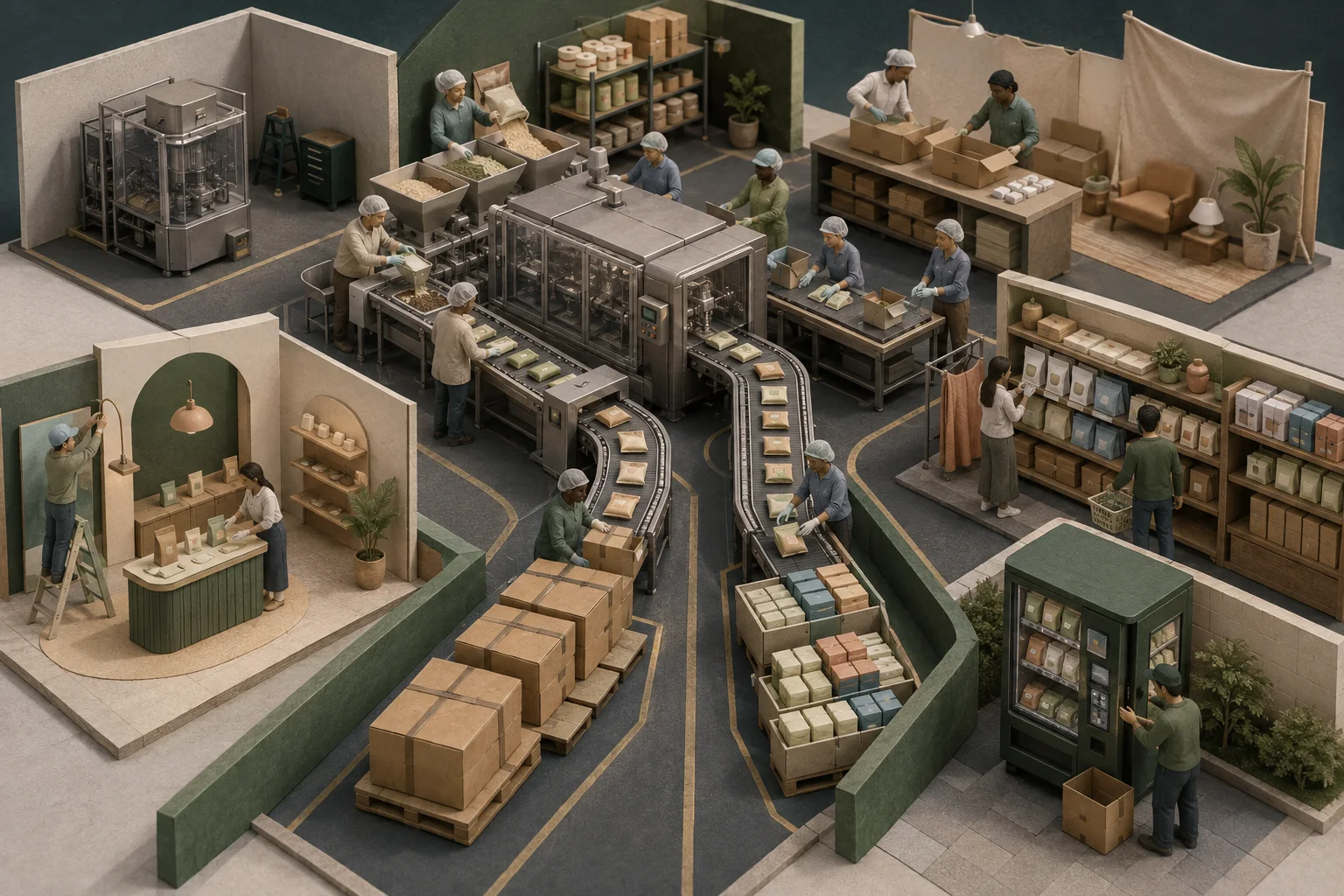
Shared production still needed separate assumptions, revenue views and reporting for each portfolio.
Later channels absorb part of direct demand instead of automatically adding another layer of sales.
Throughput, shifts and utilization determine when another complete equipment set is required.
The financing amount responds to the projected cash trough and an explicit operating buffer.
WHY THIS WASN’T A TEMPLATE EXERCISE
The model had to respect
how the business actually moved.
The reconstructed forecast separates institutional and consumer products, makes sales channels draw from a shared demand pool, links machine shifts to capacity, stages experience-store openings and derives the financing need from cash.
The funding request had to become an output
Early round-size placeholders expressed intent, not operating need. The forecast had to calculate how much capital the plan consumed after product, channel, staffing and investment assumptions were connected.
New channels could count the same customer twice
Partnerships, wholesale, branded stores and vending were intended to take share from direct e-commerce over time. Treating every channel as purely incremental would overstate volume before the factory constraint was even tested.
Product segmentation had to survive every report
Institutional and consumer products shared operations but served different commercial programs. The distinction needed to remain intact through inputs, revenue, production payroll, expense reporting and the dashboard.
Capacity and stores added costs in steps
Production equipment and physical locations do not scale as smooth percentages of revenue. Each addition brings a timed block of capital expenditure, labor, occupancy cost and depreciation.
MODEL ARCHITECTURE
From operating activity
to a decision-ready view.
Each layer has one job. Together they keep the commercial story, unit economics and cash consequences on the same timeline.
Product taxonomy
An active-product map keeps institutional and consumer lines separate and removes discontinued items from assumptions, revenue and reporting at once.
Demand and channel migration
A shared demand pool moves through direct e-commerce, partnerships, wholesale, proprietary stores and vending as each route becomes active.
Channel unit economics
Price, input cost, fulfillment and variable operating expense stay visible by product and channel, with inherited or placeholder inputs flagged for confirmation.
Production capacity
Machine throughput, available shifts and utilization convert demand into required lines, equipment timing and capital expenditure.
Workforce and overhead
Production payroll remains separate from other headcount, while a dynamic view surfaces the largest expense categories as the mix changes.
Store rollout
Opening dates trigger buildout, equipment, depreciation, management, occupancy and hourly staffing for each branded location.
Financing and cash
Operating cash, investment, working capital and existing financing roll into the minimum-cash point that determines the required raise.
WHAT THE ANALYSIS SURFACED
Useful answers,
without exposing client data.
The takeaways are intentionally qualitative. Exact assumptions, calculations and outputs remain inside the confidential client model.
The cash trough—not the preferred headline—sets the financing need
Once working capital, equipment, payroll and store openings share one timeline, the required raise can be tied to the lowest projected cash balance plus a deliberate buffer.
Opening a channel changes mix before it changes the market
A new retail or owned channel may first redirect purchases that would otherwise have occurred online. A conservation rule prevents the model from treating distribution expansion as automatic category growth.
Machine capacity turns smooth demand into lumpy investment
Sales can rise gradually while equipment arrives in blocks. Linking throughput and shifts to line additions exposes idle capacity before expansion and cash pressure when the next threshold is crossed.
Margin is only as credible as its assumption lineage
Channel contribution can look precise even when a per-unit operating cost was inherited or left as a placeholder. Making source and confirmation status visible keeps an uncertain input from masquerading as a conclusion.
MODELING APPROACH
The working system
behind the answer.
- Assumptions, scenario and minimum-cash controls
- Institutional and consumer product mapping
- Active-product and channel-migration schedule
- Channel pricing, input-cost and variable-expense schedules
- Machine, shift, capacity and line-addition model
- Production payroll and dynamic top-expense reporting
- Experience-store buildout and operating-cost schedule
- Financing, capitalization, cash-runway and dashboard views
CASE CONFIDENTIALITY
This anonymized case explains the product, channel, production-capacity, store-rollout and funding logic without naming the company, founders, lenders, investors, institutional customer, reviewers, products, partners, retailers, locations or dates. Exact product specifications, financing terms, capacity rates, prices, unit costs, staffing, store assumptions, forecasts, workbook tabs, formulas and cell references remain private because client work can be confidential or NDA-protected. The source screenshot is not reproduced. The illustration is an original fictional operating system rather than a real facility, store, product line, workbook or commercial result.