Planning the move from a retail kiosk to online sales
A specialty confectionery startup planned to begin with a compact retail kiosk and later add an online ordering channel. The forecast needed to distinguish weekly trading patterns, channel margins, stock, storage and launch investment before both paths reached the same cash plan.
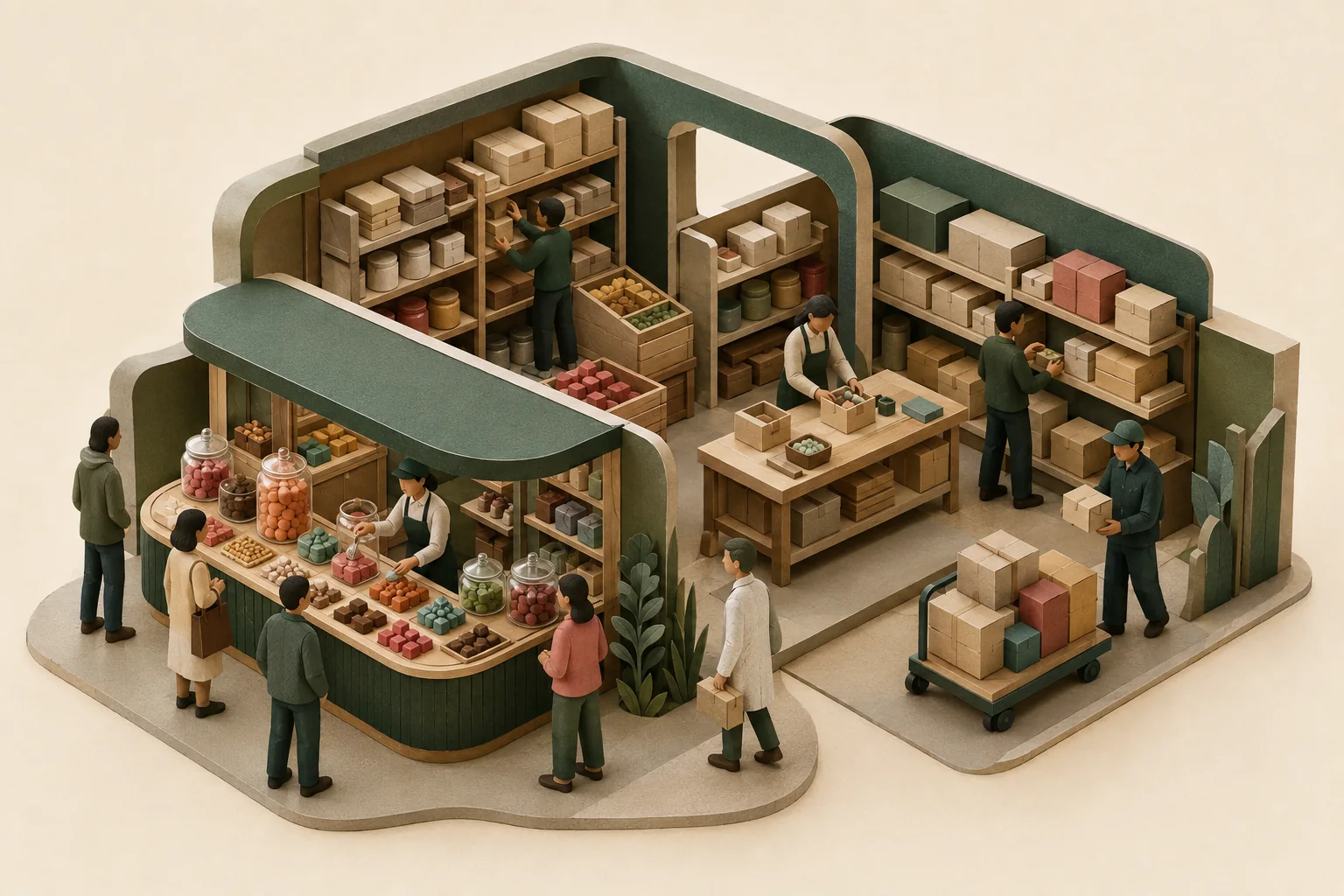
The kiosk and online channel switch on separately and retain their own daily sales and margin assumptions.
Daily trading patterns combine with monthly seasonality before revenue reaches the forecast.
Cost of goods drives safety stock, replenishment, supplier timing and the cash absorbed by inventory.
Staffing, storage, development spending, founder funding and operating cash remain synchronized.
WHY THIS WASN’T A TEMPLATE EXERCISE
The model had to respect
how the business actually moved.
The reconstructed model stages both channels separately and connects daily revenue, seasonality, margin, safety stock, storage, staff, investment and founder funding to monthly cash, break-even and valuation.
A monthly average would hide the trading pattern
The kiosk expected quieter and busier parts of the week, while demand also moved through the year. Daily assumptions therefore had to preserve both rhythms before rolling into monthly revenue.
Online sales were a second operating system
The new channel carried its own launch and ramp, sales level and cost of goods. It also introduced development work, storage and fulfillment needs rather than simply adding a percentage to kiosk revenue.
Inventory connected margin to cash
Higher demand required stock before the sale. Safety stock, replenishment timing and supplier payments could therefore use cash even when the channel looked attractive at gross-margin level.
Launch costs arrived on different clocks
The kiosk, digital build, storage, marketing and staffing did not need to begin together. Their individual activation dates had to reach one monthly cash forecast.
MODEL ARCHITECTURE
From operating activity
to a decision-ready view.
Each layer has one job. Together they keep the commercial story, unit economics and cash consequences on the same timeline.
Channel launch controls
Separate activation and ramp assumptions stage the kiosk first and let the online channel begin later without rewriting the forecast.
Daily sales engine
Early-week and later-week daily sales assumptions translate the observed trading rhythm into a monthly revenue base for each channel.
Seasonal demand layer
Monthly weights raise or lower the daily revenue engine while a full-year check keeps seasonality from creating accidental growth.
Channel contribution
Kiosk and online revenue and cost of goods remain separate so their gross contribution can be compared before consolidation.
Inventory and replenishment
Demand drives safety-stock needs, stock receipts, closing inventory, supplier-payment timing and working-capital balances.
People and operating costs
Sales staff, marketing and storage rent use their own timing and cost schedules before feeding monthly operating expenditure.
Investment and funding
Opening investment and the later digital build share a sources-and-uses timeline with founder equity and available cash.
Statements and decision outputs
Income statement, balance sheet and cash flow reconcile the operating plan before break-even, KPIs and valuation extend the review.
WHAT THE ANALYSIS SURFACED
Useful answers,
without exposing client data.
The takeaways are intentionally qualitative. Exact assumptions, calculations and outputs remain inside the confidential client model.
Channel growth changed more than the top line
Adding online sales could alter channel margin, inventory, storage and investment at the same time, so the revenue uplift could not be judged in isolation.
Seasonal launch timing magnified operating readiness
Starting near a stronger demand period increased the value of being ready, but it also concentrated stock, fulfillment and cash requirements into the same window.
Safety stock was a cash rule, not a note
Linking the reserve directly to cost of goods made the inventory requirement move with demand and reach supplier payments, the balance sheet and cash flow.
The kiosk could serve as a staged proof point
Independent launch controls made it possible to test the physical format first while preserving the full cost and operating footprint of the later channel.
MODELING APPROACH
The working system
behind the answer.
- Independent kiosk and online launch-and-ramp controls
- Daily sales model by channel and trading period
- Monthly seasonality schedule with reconciliation check
- Channel revenue, cost-of-goods and contribution schedules
- Safety-stock, replenishment and supplier-payment model
- Sales-staff, marketing and storage-cost schedules
- Opening investment and digital-development plan
- Founder funding and sources-and-uses view
- Integrated statements, break-even, KPI and valuation outputs
CASE CONFIDENTIALITY
This anonymized case explains the kiosk-to-online revenue, seasonality, inventory, storage, staffing, investment, funding and cash logic without naming the client, partners, business, location or dates. Exact sales, margins, stock, rent, pay, marketing, capital, funding, forecast, break-even and valuation assumptions remain private because client work can be confidential or NDA-protected. No source document, workbook screenshot, chart, formula, logo, model name, store name, packaging or identifying interface is reproduced. The illustration is an original fictional specialty-retail and fulfillment scene rather than a real kiosk, mall, product range, storage site, client deliverable or operating result.